It’s now been 100 years since the end of World War 1.
Just let that sink in.
100 Years.
In the overall history of mankind, it is but a blink of the eye.
But thinking about how things have “progressed” 100 years is a long time – a lot has happened since 1918.
But “progress” can be measured in lots of different ways.
If we think about health, sanitation, environment, pollution, science, technology, security, income, it’s fairly obvious that we – as the human race – have made massive progress in the last 100 years.
I’m still in absolute awe that we can be flown safely and in comfort around the world.
And that we can communicate with our friends, family and colleagues with absolute ease, wherever they are on the planet.
There are numerous examples we could talk about in terms of the massive progress we’ve made.
But there’s one area where I think we are, if anything, going backwards.
It’s over-consumption.
Now, I’m not gonna get all preachy here, or all right-on hippy either – that’s not my style, nor do I think it helps.
But I do think it helps to have the conversation.
What we are doing right now is unsustainable and will need the resources of more than the single planet on which we live.
So, what’s the answer?
There is no single silver bullet.
But there are things we can do to make “progress”
We can all do our bit in whatever way we can.
It could be to just “think” about what we are doing and the impact it has.
Do we really need that plastic tat that will be used for a second but persist in the environment for hundreds of years?
Is it so important that we have that plastic stirrer to enhance our enjoyment of our drinks?
Can we walk or cycle instead of taking the car?
Can we turn down the heating by a degree?
Can we open a conversation when we see something that will impact our environment?
Can we educate ourselves on our own personal impact?
Again, we could use numerous examples, but you get the idea.
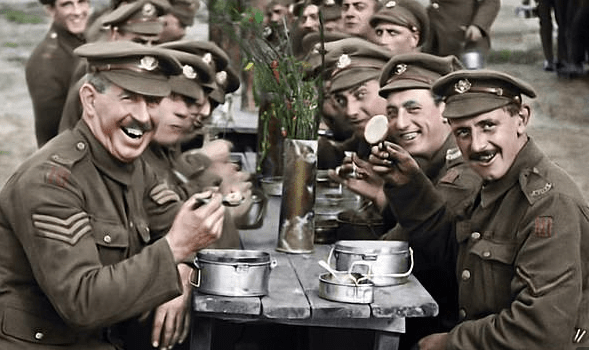
The inspiration for this was watching the documentary “They Shall Not Grow Old”.
For those that haven’t seen it, PLEASE take a look.
It brings footage of the First World War to life, by modifying the speed to real pace and converting the old footage to colour. They have also, through the magic of technology, added sound.
If you watch it and immerse yourself in it, it’s the most moving piece of film you’ll see this year!
And it is a stark reminder of the fragility of our life on this planet.
Our ancestors fought and died for the freedom that we enjoy today.
I reckon it’s a good idea to have a think about how we use that freedom for our future generations.
I get together with a group of other business owners once a month. We share insights, stories and help each other with our challenges. And have some fun too.
And last month, I was checking into a hotel after our day of planning when I was offered a complimentary newspaper.
I don’t tend to read hard copy papers anymore; like most of us I get most of my news online, but I had a couple of hours to kill, so I thought, “why not?”.
Aside from the normal Brexit stuff which I, along with most of the population, am utterly sick of (that’s a topic for another day), what caught my eye was a headline on the front page that read “Recycling industry faces fraud inquiry”.
Unsurprisingly, that piqued my interest immediately, and I dove straight in, learning a lot about what we actually do with our recycling, and the unintended consequences of government incentives to “recycle” our plastic.
To understand the scale of the problem, we need to understand a few basics, so here they are:
The UK cannot recycle all of its plastic waste in the UK, therefore it exports it to other countries that have that capability.
In January, China stopped accepting waste from the UK, so the focus has shifted to Malaysia, Vietnam, The Netherlands, Poland and Turkey. (Vietnam and Malaysia have temporary bans in place though, due to reports of high contamination rates)
Exporters make money by charging retailers and manufacturers a tonnage rate to buy “Plastic Export Recovery Notes” – this, in theory is meant to satisfy the government that they are contributing to recycling packaging.
About 100 containers of recyclable material (you know, those massive “deep sea” containers you see on the back of lorries) leave UK ports every day, bound for “recycling” in other countries.
The “fraud” bit of the headline is that companies are claiming that they have sent more than they actually have.
So, here’s what’s happening:
As consumers, we’re dutifully separating our plastics that can be recycled and putting them out to be collected.
And that – in a nutshell – is where the issue starts.
We’ve been duped into believing that by doing the right thing and putting our plastic waste in the recycling bin, that the plastic will ACTUALLY be recycled.
But here’s the thing: there’s no guarantee that it actually will – the UK exports around 60% of its plastic waste for recycling, and it’s very difficult to reliably know what happens to it once it leaves our shores.
What’s clear is that this model is not sustainable, and as a country we need to take urgent action.
If the foreign recycling markets dry up, which many think will happen imminently, what will actually happen to our plastic waste?
It will likely stay in the UK, but with no capacity to do anything with it, there’s a distinct possibility it will end up in landfill.
Which is precisely the opposite of what you expect to happen when you put your plastic in the “recycling” bin.
Now, whilst recycling abroad is better than landfill anywhere, I’m struggling to find an argument against increasing (perhaps dramatically) our plastic recycling capacity in the UK.
You’re probably thinking something along the lines of, “This is terrible, John, but what are we – as individuals – supposed to do about it?”
It’s very easy to think that there’s nothing we can do – that the system is too big and too established – but I don’t subscribe to that idea.
Sure, if there are only a few people taking action, it won’t make much of a dent in the problem, and the problem is multi-faceted anyway, so there’s no “quick fix”.
But for me, it’s individual action that starts the process and can start to make things snowball.
Here are just a few things we can all do to make a difference:
When you’re shopping, see whether there’s an alternative to that single-use plastic container.
Think about planning ahead so that the convenience of grabbing a packet of something becomes unnecessary.
Write to your MP and ask them to standardise recycling and up the UK capacity to deal with the plastic waste.
Let your supermarket know that you’re not happy with the amount of plastic that is used in their packaging. Start with the easy stuff – fruit & veg can be loose and put in paper or better still, reusable bags.
Stop using plastic carrier bags. There’s no need for them and there are plenty of alternatives. These things hang around for hundreds of years and their average number of uses is less than two!
I’ll be doing a lot more to communicate practical stuff that you can do to help, but for now, here’s something you may not know, which I found out a few weeks ago. What do you understand by this symbol, found on many products?
If you think it means that the product can be recycled, you’re not alone. Until a few weeks ago, I did too.
I was wrong.
“The Green Dot” does not mean that the packaging is necessarily recyclable at all – it merely means that the manufacturer has contributed financially to support the effort to collect and recycle common products.
So next time you see it – don’t assume that all is well, because the chances are it’s not.
Remember: reduce, reuse, recycle. These things start at home – get your house in order and then lobby the government to sort out theirs.
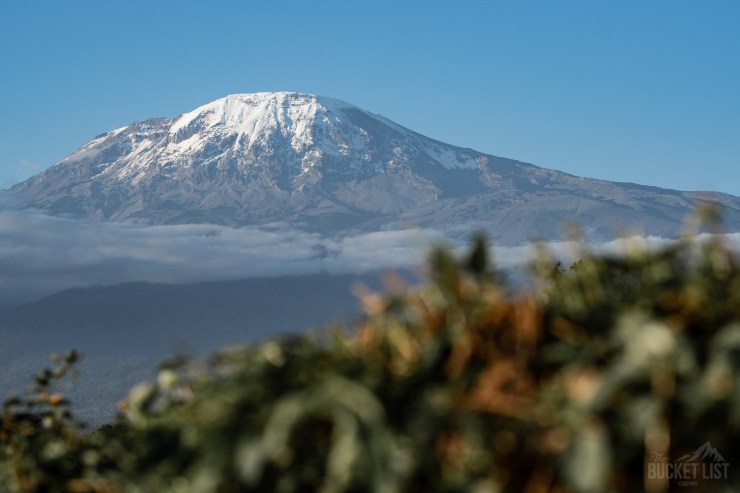
I have 2 things written on my “before I die” wall and one of them is “Climb Kilimanjaro”. My interest in the challenge started when I visited Kenya for the first time in 1995. We visited Amboseli park and Kilimanjaro was the backdrop. Wow…just wow. She rose majestically above the plains and that moment, my breath was taken away and I knew that at some point I would need to give it a go.
2017 (yeah, I know, 22 years is a bit of a gap) and I’m at a business event and bump into Keith Crockford. Now Keith, for those that don’t know him, runs “The Bucket List Company” and he’s a bit of an adventurer (and that’s a bit of an understatement). I mentioned to Keith that I’d like to climb Kilimanjaro and his response was “well you’d better book it then…if you don’t book it, it’s not happening”. At that point, I made the decision to do it….but thought that Ed (junior JT) might quite like to do it with me…how cool would that be? Father & son climbing Kili!
So, I called Ed and said “fancy climbing Kili”, to which his response was “who’s paying?” (he’s a student!). Once I’d agreed to stump up the cash, he agreed, in truth probably thinking that the idea will get kicked into the long grass…..the following day I sent him the booking confirmation – we’re going!
So, the training begins…well for me anyway. Thanks to Alex Grumley for getting to to a level of fitness where I can at least attempt this challenge. Meanwhile, I’m saying “Ed, seriously mate, it’s gonna be hard – you’d better get yourself fit”. What I’d forgotten is that he’s really young & can get fit pretty quickly…and he did. For me, I was doing OK with my training regime. That was, until about 8 weeks before the trip, my knee starts to play up….badly! I’d had a couple of operations on it when I was a teenager, but I knew there was something wrong! So, I went to a specialist and got a scan….consultant said: “you’ve got a non-functioning ruptured ACL, a torn meniscus and arthritis”. Brilliant! Going to climb a mountain in 6 weeks! His response was “yes it’s a risk but you’ve got more chance of suffering altitude sickness than the knee causing you a problem”. Good enough for me!
1st Sep comes round swiftly and we arrive at Heathrow at an ungodly hour…short flight to Schiphol and on to Kilimanjaro International. Transfer to Weru Weru River Lodge – Lovely place!
Day 2 and we meet our fellow adventurers. What a great group. Everyone excited and slightly nervous about what’s coming. A trip to Moshi to take a look around, pick up some souvenirs and back to Weru Weru. Evening comes and we have an introduction to “Whitey”, who will be our lead guide for the climb. Superb briefing which made us all feel just that bit more confident….Let’s do this.
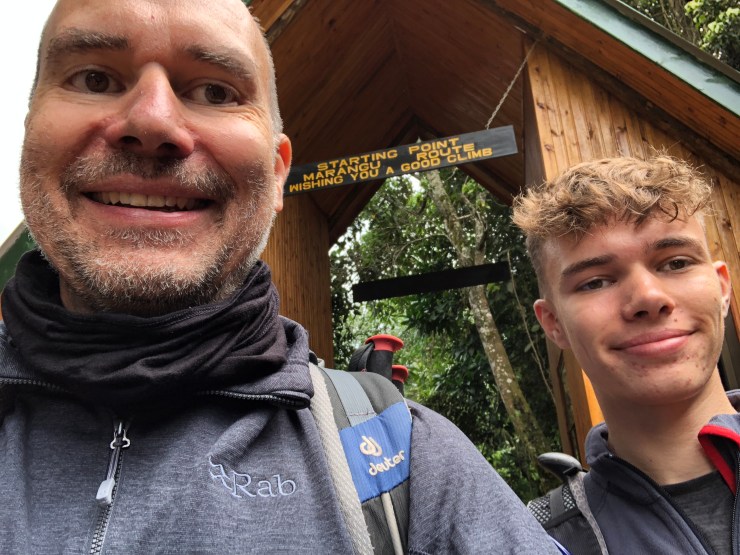
Marangu Gate to Mandara Hut
Nervous excitement at starting the trek
Day 3 and we head to Marangu gate at 1800m. Nervous excitement and we all sign-in for the climb and we just want to get on with it now. We start the trek through the rain forest to Mandara Hut, with a stop for lunch on the way. Beautiful rainforest but we can’t really see where we’re going. First experience of “hole in the ground” facilities…not the best, but manageable. Nice meal and a good nights sleep.
Mandara Hut To Horombo Hut
Day 4 and we’re heading up to Horombo at 3700 metres.
Shit!
Why on earth did you not strap up the knee from the start John?! You absolute tool !
I’m playing it down but actually thinking that I’m in a whole world of bother here.
Right, think clearly! Get the support on, get the poles out, smash the paracetamol and ibuprofen and slow down!
A few hours later and things seem to have settled down – phew!
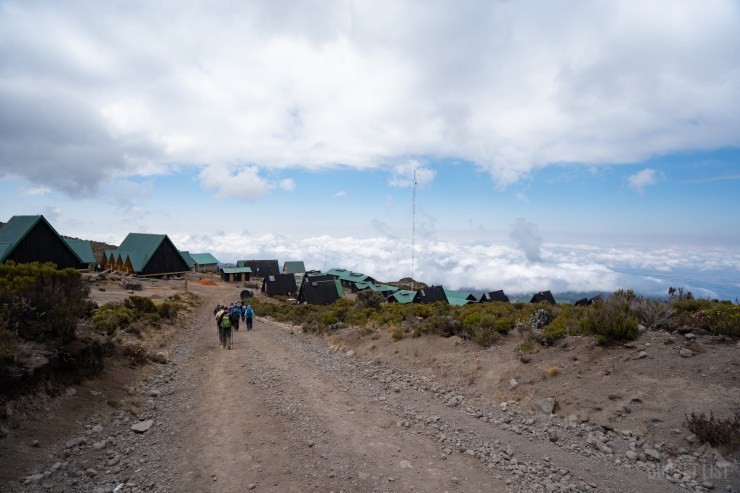
We arrive at Horombo hut and wonder at looking down through the cloud inversion. We are seriously high now and still have another 2000 metres to go!
Cloud Inversion at Horombo
Tomorrow is a “rest” day and given the knee issues, I’m thankful for that.
But before tomorrow comes, we have some “partying” to do, in the form of the guides singing and dancing, led by the charismatic “Whitey”. There’s something about the experience that stirs the soul…a whole group of people singing and dancing together at 3700 metres up the mountain…and we’re all encouraged to join in and it’s hard not to!
After all that jigging about, I’m starting to feel a bit queasy, so have to be still for a bit. At this point, I’m not sure whether it’s altitude, change of diet, change of water or physical exertion that’s making me feel that way….no matter, it soon passes & we settle into the hut for a well-earned sleep.
(Sleep, by the way, for those of us who are not used to a mummy sleeping bag, is at best broken – how on earth can you turn over in that. I felt a bit sorry for my roomies, as I must have sounded like a rustling crisp packet in a silent cinema as I tried to get comfortable).
Horombo Hut to Zebra Rock (and back)
Day 5 and we’re heading up to “Zebra Rock”, which is only about 500 metres higher than the camp at Horombo, but a vital acclimatisation trek. Some great pics were taken at Zebra and a relatively easy walk back to Horombo for some downtime.
Then more partying with Whitey and the guides, but I’ve learned my lesson and take it easy and take more of a watching roll. Great fun! Early night as it’s a loooong day tomorrow.
Horombo Hut to Kibo Hut
Day 6 and today we get really high. Up to 4700 metres to Kibo hut. Bit of a dicky tummy this morning & my bag has already been taken by the porters so need to scrounge some Imodium…Not ideal, but manage to force some breakfast down, along with a hot drink. The terrain became a bit more barren into the alpine desert. The path to Kibo hut was visible and long. The further we walked, the farther away the hut seemed! At this altitude, we start to get a few symptons…a few of us feeling the effects by the time we reach Kibo.
In truth I found Kibo to be a bit grim….partly because I wasn’t feeling too great and partly because we just didn’t get enough time to rest prior to the summit attempt. We arrive early evening there and hang around for a bit waiting for food…. Then we have a bit of talk from Whitey and the rest of the guides who will be helping us to the summit. What to say about that talk….well, I don’t think there was a dry eye in the house – Whitey and the crew were inspirational and I think the quote we all remember was “Pain is temporary, but the achievement of reaching the summit will last a lifetime”. Woah…. We’re all very quiet and clearly nervously excited about what we’re about to do.
“Right then, get a couple of hours rest, and we’ll wake you up at 11pm”
Summit Night!
Day 7 – Summit day! Well actually, we started before midnight on day 6, but that’s splitting hairs. We get our kit together and gather outside. We are all layered up and get our head torches on. The head torches were pretty much the only light we had, lighting a few feet in front so we could see where we’re planting our feet. We start very pole pole (slowly slowly) with Ed and I somewhere near the rear. With the lead guide setting the pace, we’re getting a bit frustrated because with the concertina effect, we’re a bit stop-start and can’t get into a rhythm…and with all the layers, it’s hot, so need to unzip a bit. An hour or 2 in and Buga (a guide who I shall be forever grateful to), looked at me and said “trust me, I need to take your backpack”. Now at this point, I thought I was doing just fine, but he clearly saw something and thought I needed some help…turns out, he was right.
One foot in front of the other is a mantra that will stay with me forever, and that’s about all I could manage.
As we looked up into the darkness toward the summit, it was impossible to differentiate between head torches and stars. As we zig-zagged up towards Gillmans point, I was feeling like I was running on fumes. How I was going to take the next single step was a mystery to me. I had nothing left & this was the first time that I doubted whether I could make it. Feeling like I needed fuel on board I remembered that I had some Jelly Babies in the bag, so asked Buga to get the Jelly Babies….I tried to have a couple but could only manage one! Wow, who can only manage one jelly baby?! Altitude has a very real effect on your appetite and I was feeling it! Throughout this, I was really lucky to have Ed at my side – he was relentlessly positive and of all of us, he was probably coping with the altitude the best….which was pretty fortunate as he retained the presence of mind to keep me going..”Dad, you’ve got this…we’re nearly there, just one foot in front of the other”.
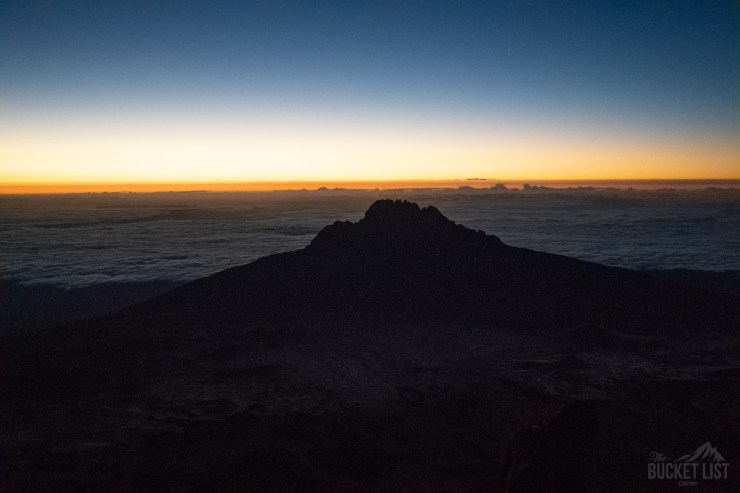
As the sun rose above the clouds, the burst of heat was very welcome.
Before we reached the rocks on the approach to Gillmans, I stopped again (well, collapsed really), needing to catch some breath….where on earth was I to find the energy for the next step? Another pep talk from Ed and Buga and we were on our way again (slowly!).
My recollection is a bit sketchy from about 5200 metres, but I do remember getting to Gillmans Point….apparently there were hot drinks there, but I have no recollection of that and don’t remember whether I had a drink at that point. I do remember looking across the crater rim towards Uhuru Peak.. I turned to Ed and said something like “Sorry dude, I just can’t do it”. He looked me square in the eyes and said “Dad, you’ll regret that for the rest of your life. You haven’t travelled thousands of miles to give up now. You’ve got this! Come on, we’re doing it”.
As I write that, I still feel emotional. It was the defining moment of the trip and without those words, I would have happily stayed at Gillmans.
On we went though, stopping every few steps to catch breath.
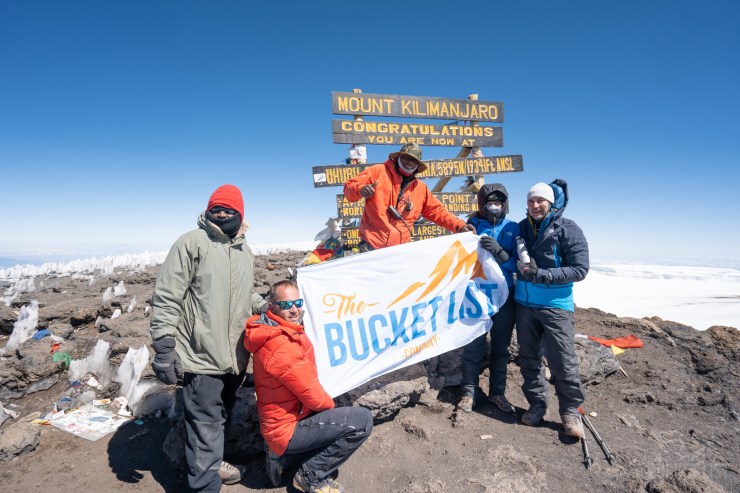
A few hours later, we approached Uhuru Peak. We could see most of the Bucket Listers were already there. By the time we got close, they were starting to make their descent and there were quite a few fist bumps as we passed each other with a few comments like “Jeez, how are you here?”…they had seen what a state I was in prior to Gillmans!
We’ve made it! I don’t know quite what it was that made this such an emotional achievement….the scale of the challenge, the fact that it was sooo hard, the fact that we’d done it together, the fact that there were friends, old and new, that had achieved together. But it was very emotional.
Ed at the summit
Me at the summit (looking a bit broken!)
Me & Buga (what a guy)
Keith, Buga, Ed and me at the Summit
The pictures are all about the peak, but once we had arrived there, the challenge wasn’t over – we needed to get back down the mountain. After the brief pictures and a bit of a rest, we started back to Gillmans….I have very little recollection of this bit, but Ed has since told me that I was being very weird and not making any sense at all. We had to rest every few steps while I rested on my poles and by the time we got back to Gillmans, I was in a bad way. Buga said to me that he had to get me off the mountain and the next thing I remember was “skiing” down the scree, supported by Buga, back toward Kibo.
OK, starting to feel a bit more human again at the lower altitude (we’re still at 4700 metres though!) and looking forward to a rest….no such luck!! We were quite late back to Kibo and our bunks needed to be vacated for the next batch of summiters. So, it was a quick hot drink and snack and then heading back to Horombo. In truth, I couldn’t wait to get back to Horombo and when we reached that point after about 4 hours of trekking (it was dark by then too!), dinner was served, but nobody cared – we all just went to our hut, climbed into the sleeping bag and got some well-earned shut-eye. BEST SLEEP EVER! Didn’t care about the mummy sleeping bag – just wanted to sleep!
Back to Marangu Gate
Day 8 and we’re all very much looking forward to getting back to the gate and to Weru Weru for a shower and beer! The trek was long, but easier on the body, except for the calves, which were burning like an inferno by the time we reached the gate! Congratulations and re-capping of the stories back at the gate as we try to take in what we’ve achieved.
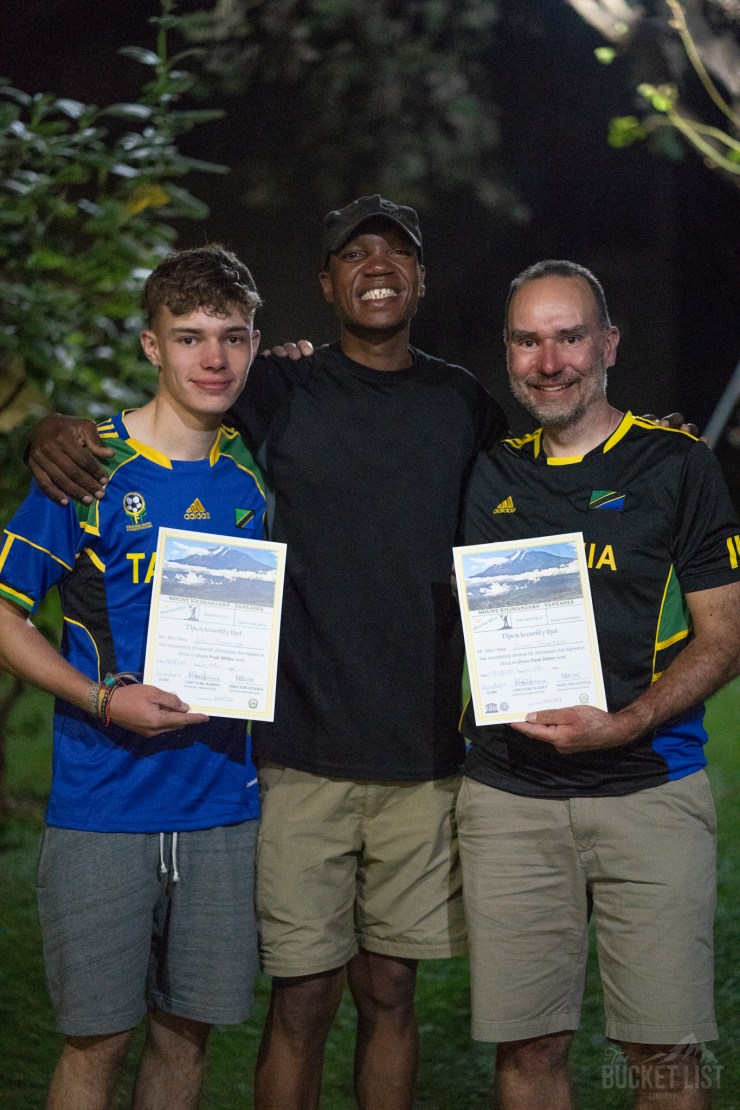
Back at Weru Weru and a hot shower and a lovely presentation from Whitey and a proper BBQ meal too.
Hardest earned certificate ever!
We went on a 3 day safari the following day & I’ll do a separate bit on that (it was fab!).For now though, some key takeaways:
Kilimanjaro is awesome in every respect.
Africa is a wonderful place to be.
To achieve something of real magnitude takes great mental strength.
This was a team effort, for all of us.
When you think you have nothing left, you’re probably wrong.
Words matter
There’s no substitute for sheer determination
I will be forever grateful to Ed. He has a wise head on young shoulders and without his words, I don’t think I’d have made it to the summit.
I’m also grateful to Keith, Whitey and Buga – impossible without these guys.
The guides and porters are made of different stuff – I think they are hewn from granite!
To be fortunate enough to have the opportunity to take on this challenge and reach the roof of Africa with my son is incredible.
We funded this ourselves, so if you’d like to contribute a little to our chosen charities, 100% will go to them & we’d really appreciate it:





 JT's insights